




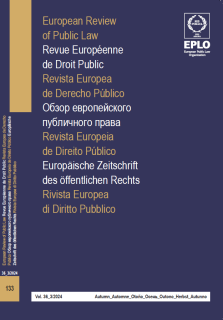
ERPL vol. 36, no 1, spring/printemps 2024 (133)
This issue of the ERPL continues to pursue its mission of offering high-level scholarly reflection and comparative insight across the field of public law, presenting contributions that span doctrinal analysis, legislative developments, and jurisprudential interpretations from a variety of jurisdictions.
- Summary
Articles
D. Vese, The Right to Free Speech between Conceptual Evolution, Legal Protection, and Jurisprudential Practice [IN ENGLISH] (40 pp.)
R. Royal, La théorie des systèmes comme cadre d’analyse juridique de la privatisation. Éléments de droit constitutionnel comparé [IN FRENCH] (51 pp.)
M. Yasin, Giving Legal Effect to Unlawful Administrative Decisions [IN ENGLISH] (17 pp.)Chronicles / Chroniques
I. Constitutional Law / Droit constitutionnel
J. Fux, Austria / Autriche [IN GERMAN] (15 pp.)
E. Láštic, Slovakia / Slovaquie [IN ENGLISH] (8 pp.)
M. Semih Gemalmaz, Türkiye [IN ENGLISH] (9 pp.)
N. V. Mishyna, Ukraine [IN FRENCH] (21 pp.)II. Administrative Law / Droit administratif
D. Renders / M. Lombaert / E. Taylor, Belgium / Belgique [IN FRENCH] (55 pp.)
Choon / M. Viana Pedreira, Portugal [IN ENGLISH] (18 pp.)
Yu. O. Leheza, Ukraine [IN ENGLISH] (28 pp.)
L. Graham, United Kingdom / Royaume-Uni [IN ENGLISH] (22 pp.)III. Jurisprudence
A. M. Reis / A. M. Abrantes / M. Bastos Graça, Constitutional Jurisprudence, Portugal [IN ENGLISH] (35 pp.)
Book Reviews / Notes bibliographiques
B. Leitl-Staudinger, [IN GERMAN] (14 pp.)
Z. A. Ivantsova, [IN GERMAN] (14 pp.)Books Received / Livres reçus (3 pp.)
- Editorial
The first article explores the historical, literary, and legal reasons for the protection of the freedom of expression in legal systems in Western countries as one of the most valuable assets which public authorities do not restrict, and tries to understand whether this is the case. The main argument is that we are in a transitional phase and that fundamental human rights, such as freedom of expression, are still subject to intrusive forms of restriction.
The second article applies systems theory as a framework for analyzing legal aspects of privatization in comparative constitutional contexts; it poses the question of whether Niklas Luhmann’s theory of social systems constitutes a relevant theoretical framework for the analysis of constitutional limits to which privatization is exposed? The paper aims at comparing the limits that French, German and British constitutional law place on privatization, and registering these three systems within their common European context. After highlighting the obligations of State bodies to guarantee this functional differentiation, the article highlights the need for the State to maintain a minimum competence to regulate privatized activities, as well as this of overcoming the distinction public law/private law through this regulation.
The third article focuses on the question of whether unlawful administrative decisions in favour of individuals should be given legal effect. Although an unlawful administrative decision should ordinarily be removed from the legal order, this article analyses in which cases such decisions should be preserved. These exceptional cases are analysed in terms of the principles of administrative law, and the necessity of establishing a balance between different legal principles is emphasised. Although there is no definitive answer to the question, the jurisprudential approach developed by the Turkish Supreme Administrative Court for a long time on this issue is presented, and the dimensions that need to be discussed are pointed out.
In the Chronicles of Constitutional Law, we begin with Austria, where constitutional developments in 2023 and 2024 remain selective but significant, including the abolition of official secrecy and the introduction of a Freedom of Information Act. Constitutional court rulings also presented a very diverse picture during the period under review, from dealing with state-run legal advice in asylum law, demanding legally enshrined guarantees of independence, cancelling provisions on the seizure of data carriers in criminal proceedings due to data protection and privacy considerations, and annulling the central provision on the granting of legal aid as unconstitutional. The report then contains a cursory description of the Constitutional Court’s case law on climate claims, which to date has been characterised by rejections of corresponding applications and an associated focus on admissibility requirements. In the related area of animal protection, the Constitutional Court, on the other hand, annulled a 17-year transitional period for the ban on fully slatted floors in pig farming as unconstitutional at the request of a provincial government. The report concludes with a presentation of recent Constitutional Court rulings on suicide.
The chronicle from Slovakia follows with a focus on the country's parliamentary and judicial dynamics. The first part of the chronicle analyzes political and legal discussion surrounding the extensive 2024 Criminal Code amendment, introduced as the first major legislation by the new ruling coalition following the 2023 parliamentary election. In the second part, the chronicle looks at the 2024 decision of the Constitutional Court on the constitutionality of the 2024 Criminal Code amendment.
The chronicle from Türkiye outlines the evolving jurisprudence concerning democratic governance and fundamental rights, outlining the challenges constitutional presented by government intervention in Türkiye’s judicial system.
Ukraine’s constitutional law chronicle examines the development of constitutional law in 2023, with a particular focus on legislative adaptations in response to martial law and evolving democratic norms. It presents an analysis of 8 key laws that illustrate Ukraine’s legislative strategy in a time of crisis and its commitment to both domestic stability and European integration. By examining the Law on Legislative Activity, the Laws on employment and social protection, defence legislation and local government reforms, this article assesses Ukraine’s efforts to increase transparency in governance, protect human rights and strengthen institutional resilience. The study highlights how Ukraine’s legal reforms reflect an adaptive legal framework that addresses wartime challenges while supporting broader democratic and constitutional goals.
In the Chronicles of Administrative Law, the report from Belgium outlines reforms and challenges in federal and regional administration. Concerning the organisation of local administrations, the article analyses how the Court of Justice of the European Union ruled, following a preliminary question, on the prohibition of wearing signs likely to reveal an ideological or philosophical affiliation. Regarding access to environmental information, the Belgian Constitutional Court ruled that the decree introducing an exception to the principle of public disclosure of administrative documents in environmental matters – where the request for disclosure relates to ‘internal communications’ – is compatible with the principles of equality and non-discrimination and does not infringe the standstill principle.
Portugal’s chronicle provides an overview of the amendments Decree-Law 10/2024 has introduced to the urban planning licencing in Portugal, focusing on the elimination of the need to obtain urban planning licences; tacit approval of licencing applications; the simplification of the licencing procedure; and the standardisation of the rules applicable to urban licencing procedures in all municipalities. It also provides an overview of the amendments introduced by Decree-Law 43-A/2024 in the functioning and organisation of the direct administration of the State, focusing on the networking model of functioning, the creation of common or shared support structures, the specialisation of services, and integrated information systems.
The administrative law chronicle from Ukraine highlights the problems of creating an organizational and legal mechanism for ensuring the realization of the individual’s right to environmental education. This scientific article applies both general scientific methods of learning social phenomena (methods of synthesis and analysis, the structural-logical method), and specific scientific methods, among which the method of comparative jurisprudence, methods of legal norm-making, etc. are distinguished. It was found that one of the priorities of the development of Ukrainian society in accordance with the Strategy for the implementation of the State environmental policy until 2020 was the formation of an appropriate level of environmental legal awareness and environmental legal culture.
The United Kingdom chro provides an analysis of recent administrative law jurisprudence and trends relating to the principle of legality and procedural fairness. In 2023, UK courts handed down a number of important judgments relating to constitutional fundamentals, human rights law and judicial review. In relation to constitutional fundamentals, the most important judgments related to constitutional statutes and the validity of ouster clauses. The most interesting human rights cases related to retrospective sentences, historic investigations, political parties, and the government’s Rwanda policy. There were also a number of cases which developed or clarified the operation of standard grounds of administrative review.
The Jurisprudence Chronicle features Portugal’s constitutional jurisprudence, which gives an overview of the Portuguese Constitutional Court case law of 2023. The Court faced relevant challenges in different fields of the Portuguese legal framework. As usual, Criminal and Tax Law stood out as the main legal areas approached by the Portuguese Constitutional Court. In Criminal Law, medically assisted death, seizure of electronic mail within the scope of administrative offence proceedings for anticompetitive practices and retention of traffic and location data to be used in criminal proceedings are some of the topics to be highlighted. In Tax Law, there were relevant decisions concerning, among others, taxation of the Energy Sector, taxation on vehicles and its compatibility with European Union Law and double taxation in income matters under bilateral conventions.
Finally, the Book Reviews section presents reviews of notable publications in Austria and Ukraine, and is concluded by a chronicle reviewing the four books received by the EPLO Library in the year 2024.